
Are Peptides Legal for Clinical Use? A Guide for Clinics
If you run a licensed clinic, this question comes up more often than ever: are peptides legal for clinics?
It is a fair question. The peptide market has exploded across wellness, weight management, hormone care, aesthetics, sports recovery, and age management. Therefore somewhere in the middle, licensed clinics are left trying to sort through what is actually legal, what is compliant, and what creates unnecessary risk.
The short answer is simple.
Some peptide related therapies may be legal for clinical use in the United States, but only in very specific circumstances. Legality depends on what the substance is, whether it is an FDA approved drug, how it is sourced, what it is prescribed for, whether compounding rules are met, and whether the clinic follows state and federal requirements.
That is the part many people miss.
This guide is written for licensed clinics and medical professionals who want a clearer, practical view of peptide legality medical use in the U.S. It is not medical or legal advice. It is an educational overview meant to help licensed professionals ask better compliance questions and reduce avoidable risk.
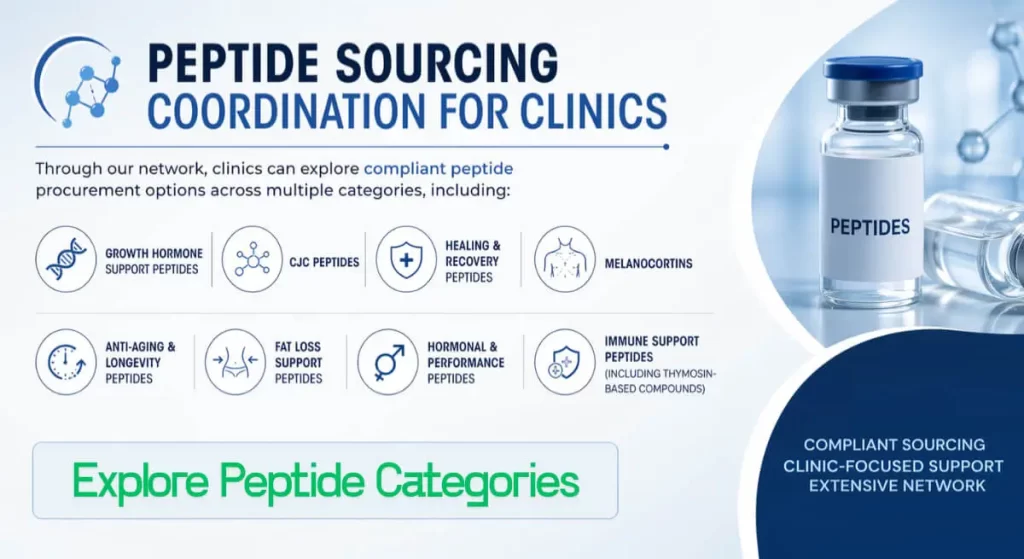
Injecta Connect operates solely as a liaison platform and its peptide sourcing network helps licensed clinics access to a wide array of licensed US suppliers. Injecta Connect does not provide medical advice, patient care, prescribing, compounding, or dispensing services.
Why peptide legality feels confusing
A lot of the confusion comes from the fact that the word peptide is used very loosely.
In casual conversation, people often lump together:
- FDA approved peptide or peptide related drugs
- compounded peptide preparations
- research use only products
- bulk peptide powders sold online
- hormones and analogs that are discussed alongside peptides
- products marketed in wellness communities but not approved for human clinical use
Those are not all treated the same under U.S. law.
For a clinic, this distinction matters because the legal status of a product changes the compliance picture completely. A medication with FDA approval and established labeling is very different from a bulk substance offered through a nontraditional source with unclear regulatory standing.
A practical starting point for clinics
When a clinic asks, are peptides legal for clinics, the best first step is not to ask whether the category is legal.
It is to ask whether the specific product is legally marketable and clinically appropriate within a compliant framework.
Here is a simple way to think about it.
| Question | Why it matters |
|---|---|
| Is the product FDA approved for human use? | FDA approval gives the clearest legal foundation for prescribing and administration |
| Is the product being obtained through a properly licensed supply chain? | Sourcing affects safety, traceability, and regulatory exposure |
| Is the intended use consistent with approved labeling or lawful prescribing standards? | Off label use can be lawful in some settings, but marketing and sourcing still matter |
| Is the product compounded? If so, does it meet federal and state compounding rules? | Compounded drugs are subject to additional restrictions |
| Does the clinic have documentation, protocols, informed consent, and oversight? | Clinical peptide compliance is not just about the substance itself |
| Are there state specific rules affecting administration, delegation, and prescribing? | State boards may impose tighter standards than federal law alone |
That framework alone can help a clinic avoid a surprising number of problems.
What counts as legal for clinical use
In broad terms, a drug used in a licensed clinic is on firmer legal ground when it is:
- FDA approved for human use
- prescribed by a licensed professional acting within scope
- sourced through lawful channels
- administered in compliance with state and federal requirements
- documented appropriately in the patient record
This sounds obvious, but it matters because many peptide discussions online skip over these basics.
For example, if a substance is sold as research use only, that is a major red flag for clinical administration. Research use only does not mean suitable for patient care. It generally means the opposite.
Likewise, if a vendor cannot clearly establish that the product is a legally marketable human drug, a clinic should slow down immediately.
FDA approved peptide and peptide related drugs versus non approved products
This is one of the most important distinctions in peptide regulations clinics need to understand.
FDA approved products
Some peptide or peptide related medications do have FDA approval and labeled human use indications. These products come with approved prescribing information, safety details, and recognized manufacturing pathways.
Examples commonly discussed in clinical settings may include certain GLP 1 receptor agonists, gonadotropins such as Pregnyl for hCG, and some hormone related therapies that are often discussed near the peptide category.
These are not interchangeable with unapproved compounds sold online.
Unapproved or unclear status products
Some substances promoted as peptides in wellness and anti aging communities may not be FDA approved drugs for human use. Others may be the subject of ongoing regulatory scrutiny, compounding limitations, enforcement trends, or marketing claims that go beyond the available evidence.
That does not automatically make every discussion around them unlawful. But it does mean clinics need a much higher level of diligence before considering any use pathway.
A good rule of thumb is this: if the legal status is fuzzy at the supplier level, the clinic risk is already elevated.
Compounding changes the compliance picture
This is where many clinics get tripped up.
A peptide may be talked about widely in clinical communities, yet the actual compounded version being offered could still create regulatory concerns depending on the substance, the source, and the compounding framework.
Under federal law, compounding is generally governed under sections such as 503A and 503B of the Federal Food, Drug, and Cosmetic Act, alongside FDA guidance and state pharmacy board oversight. Whether a compounded preparation is permissible can depend on factors such as:
- whether there is a valid patient specific prescription in the 503A setting
- whether the substance is on an applicable bulks list or otherwise permitted
- whether the compounded drug is essentially a copy of a commercially available drug
- whether the outsourcing facility or pharmacy is operating lawfully
- whether there are state level restrictions
For healthcare providers, this means peptide compliance for clinics is not simply about whether a patient wants a therapy. It is about whether the final product being used exists within a lawful and well documented supply chain.
Red flags clinics should not ignore
Sometimes the easiest way to understand legality is to look at warning signs.
Here are some common red flags.
| Red flag | Why it matters for clinics |
|---|---|
| Product labeled research use only | Generally not appropriate for human clinical administration |
| Vendor avoids clear discussion of FDA approval status | Suggests legal and sourcing risk |
| Bulk peptide powder with little supply chain transparency | Raises concerns about quality, traceability, and lawful use |
| Marketing claims that sound exaggerated or disease focused | Can signal regulatory issues and reputational risk |
| No clear pharmacy relationship or compounding basis | Weakens compliance foundation |
| Product offered without current labeling or package insert | Makes verification harder |
| Staff are unsure whether use is based on approved product, compounding, or internet sourcing | Indicates internal compliance gaps |
For a clinic owner, these are not minor issues. They can affect licensure, board scrutiny, payer concerns, patient trust, and business continuity.
What compliant clinics typically do differently
Clinics that handle peptide regulations well tend to slow down and build process before they build marketing.
That usually includes:
- verifying whether a therapy is based on an FDA approved drug
- reviewing current FDA labeling and manufacturer information
- confirming pharmacy or distributor licensure
- documenting why the therapy fits the clinic’s scope and model
- training staff on what can and cannot be said to patients
- separating education from promotion
- creating written protocols for prescribing, storage, administration, and follow up
- reviewing state law and board expectations
- consulting qualified healthcare counsel when needed
This is the heart of peptide compliance for clinics. It is operational, not just theoretical.
Off label use does not mean anything goes
Another area of confusion is off label prescribing.
In the U.S., licensed prescribers may prescribe approved drugs off label in certain circumstances. But that does not create a free pass for any product, any claim, or any sourcing method.
A few important points:
- off label use generally applies to legally marketed approved drugs
- it does not legitimize research use only products for patient care
- it does not erase compounding restrictions
- it does not protect misleading marketing
- it does not override state board rules or standard of care expectations
So if a clinic is relying on off label use as the core answer to legality, it should pause and look deeper.
How to talk about peptides with patients without creating unnecessary risk
This matters because patient demand often drives the conversation.
A safer communication approach usually includes:
- describing whether the product is FDA approved or compounded
- avoiding sweeping claims about outcomes
- making no promises around cure, reversal, or guaranteed benefit
- using informed consent language that is balanced and understandable
- documenting the clinical rationale and patient discussion
- ensuring nonclinical staff do not drift into counseling or prescribing language
For liaison partners, marketers, and support teams, this boundary is especially important. Educational content should stay educational. It should not cross into patient specific medical advice.
A simple clinic checklist for evaluating peptide legality
If your team is assessing a peptide or peptide adjacent therapy, this quick checklist can help.
| Compliance question | Yes | No | Needs review |
|---|---|---|---|
| Is there an FDA approved drug involved? | |||
| Have we reviewed current FDA approved labeling? | |||
| Is sourcing through a properly licensed and verifiable channel? | |||
| If compounded, have we reviewed 503A or 503B implications? | |||
| Do state law and board rules allow our intended workflow? | |||
| Are prescribing and administration roles clearly assigned? | |||
| Do we have informed consent and documentation protocols? | |||
| Have staff been trained on compliant communication? | |||
| Have we reviewed legal and compliance risk before launch? |
A clinic that cannot answer most of these confidently is probably not ready to promote or operationalize that therapy.
The business risk is real, not just the clinical risk
It is easy to think of this as only a clinical issue, but it is also a business issue.
Poor peptide compliance for clinics can lead to:
- board complaints
- pharmacy relationship disruptions
- payer or partner concerns
- inventory loss
- reputational harm
- patient dissatisfaction tied to unclear expectations
- scrutiny over advertising and consent practices
That is why smart clinics treat compliance as a growth function, not as a roadblock.
Done well, it actually creates trust.
Key takeaway for licensed clinics
So, are peptides legal for clinics?
Sometimes yes, but only when you are talking about a specific therapy with a lawful clinical pathway. The category itself is too broad to answer with one simple yes or no.
The safest working model is this:
- start with FDA approved drug labeling whenever possible
- verify legal sourcing
- understand whether compounding rules apply
- separate approved drugs from research products
- train staff carefully
- build documentation and oversight into operations
- review both federal and state requirements before offering a therapy
If a product’s legal status is unclear, a clinic should treat that uncertainty as a risk signal, not as a marketing opportunity.
That may sound conservative. Honestly, it is. But for licensed clinics, conservative compliance is often the most practical path.
Final disclaimer
This article is for educational and informational purposes only. It is written for licensed clinics and medical professionals in the United States. It does not provide medical advice or legal advice and should not be used as a substitute for review by qualified healthcare counsel, compliance professionals, pharmacists, or licensed prescribers.
InjectaConnect is a liaison only. InjectaConnect does not provide medical advice, patient care, prescribing, compounding, or dispensing services.
Clinics should rely on current FDA approved drug labeling, manufacturer prescribing information, state law, board guidance, and qualified professional counsel when evaluating any peptide, hormone, or peptide related therapy.