
Peptide Sourcing for Clinics: A Clinical Guide & Supply Overview
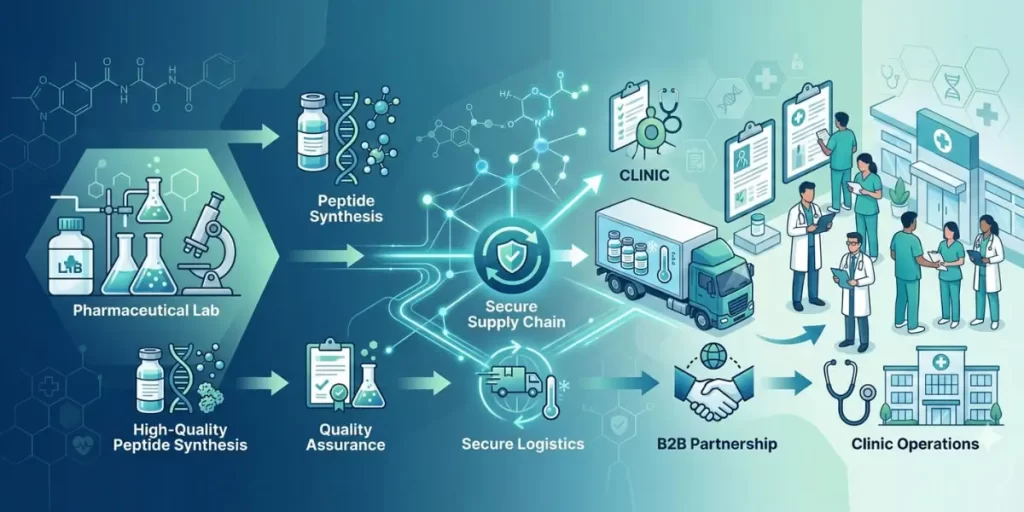
Running a modern medical practice involves a lot of moving parts—from patient care and staffing to insurance billing and marketing. For many clinics, sourcing peptides for clinical use has also become an operational challenge. This includes navigating clinical peptide procurement services through licensed pharmacy partners while maintaining the full regulatory compliance.
Therefore if you are reading this, you probably know that peptide therapy has moved from the fringes of functional medicine right into the mainstream. Whether it is for weight management, injury recovery, or general wellness, patient demand is at an all-time high.
But here is the catch. The supply chain is complex. It can be fragile. And frankly, it can be confusing.
This guide is designed to walk you through the B2B landscape of medical peptide sourcing for clinics. We want to help you understand how the supply chain works, the difference between a research supplier and a pharmacy, and how to protect your license while keeping your shelves stocked.
For a detailed breakdown of internal ordering and coordination steps, refer to our guide on peptide procurement process for clinics.
Why Peptide Supply Matters for Modern Clinics
A few years ago, sourcing injectable therapies was fairly straightforward. You had your major distributors, and you had your local compounding pharmacy.
Today, the landscape has changed. The rise in popularity of the GLP-1 agonists and the use of the therapeutic peptides have caused a shortage. A shortage is not just a problem for a clinic owner; It means canceling appointments. It means interrupting patient care plans. It means revenue loss.
Establishing a robust clinic peptide supply chain is no longer just a “nice to have.” It is a critical business survival skill. You need redundancy. You need quality assurance. And most importantly, you need partners who understand the regulatory environment as well as you do.
Understanding the Players in Clinical Peptide Supply Chain
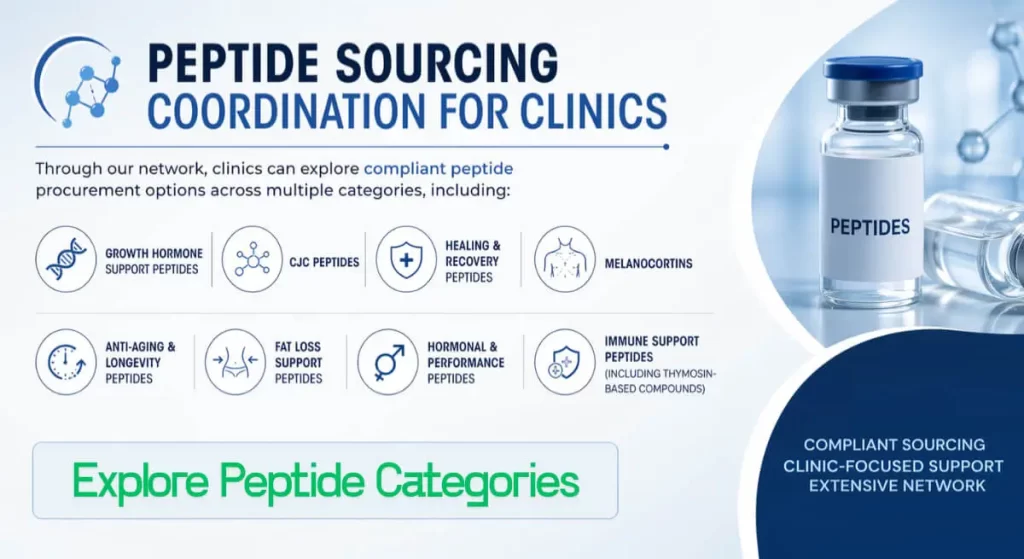
To master medical peptide sourcing, you have to understand the different entities in the chain. There is often confusion about where the product actually comes from. Let us break it down simply.
1. API Manufacturers
These are the companies that make the raw powder. API stands for Active Pharmaceutical Ingredient. Legitimate API manufacturers are FDA registered facilities. They sell bulk powders.
Note: Clinics generally do not buy from here. You are not a manufacturer. You do not have the equipment to turn raw powder into a sterile injectable.
2. 503A Compounding Pharmacies
This is where most independent clinics have traditionally sourced custom medications. A 503A pharmacy compounds medication pursuant to a specific patient prescription.
The process: You see a patient. You write a prescription for that specific patient. You send it to the 503A pharmacy. They make it for that patient.
3. 503B Outsourcing Facilities
This is the big leagues for clinic peptide supply chain logistics. A 503B facility is an outsourcing facility that can manufacture large batches with or without patient specific prescriptions. They are held to much stricter cGMP (Current Good Manufacturing Practice) standards, similar to big pharmaceutical companies.
The benefit: This allows for “office use” ordering in states where it is permitted. This is crucial for clinics that want stock on hand.
4. Liaison and GPO Services (Like InjectaConnect.Com)
This is where we fit in. We are not the pharmacy and we do not make the drug. You can look at us as connectors. Clinics often work with liaison platforms to connect with appropriate pharmacy partners that have stock, fair pricing, and rigorous quality standards. A Liaison or a GPO service provider handles your account setup headaches so you can focus on patients.
The Danger of “Research Use Only”
We have to touch on this because it is the biggest risk in peptide suppliers for clinics.
You will see websites selling peptides labeled “For Research Purposes Only” or “Not for Human Consumption.” These are often sold as lyopholized (freeze dried) powders in vials.
Using these for patient care is a massive liability. These products:
- Are not for human use.
- Do not undergo the sterility testing required for injectables.
- Are not sourced from FDA regulated pharmacies.
If a clinic sources from these vendors to treat patients, they are risking their medical license and patient safety. Licensed US-based pharmacies or outsourcing facilities always supply legitimate B2B peptides for medical use.
Peptide Supplier vs. Compounding Pharmacy
It is helpful to visualize the difference between the entities you might encounter. This table helps clarify the peptide supplier vs compounding pharmacy confusion.
| Feature | Research Chemical Site | Compounding Pharmacy (503A/B) | Liaison / Connector |
|---|---|---|---|
| Target Audience | Researchers / Lab Use | Patients / Clinics | Clinics / Providers |
| Product Type | Raw powder / Non-sterile | Sterile medication | Service / Support |
| FDA Oversight | Minimal to None | High (State Board + FDA) | N/A (Business Support) |
| Medical Use? | Strictly Prohibited | Allowed / Intended | Facilitates Connections |
| Prescription? | No | Yes (Required) | No (Connects you to Pharmacy) |
| Safety Testing | Rarely for sterility | Mandatory | Vets the Pharmacy |
For more information read Peptide Supplier vs Compounding Pharmacies: What Clinics Must Know?
The Growth of Peptide Therapy Clinics in the United States
The rise in demand for peptides for medical providers tracks perfectly with the shift toward personalized medicine. Patients no longer accept a ‘wait until you get sick’ approach. They want optimization.
Market research suggests the peptide therapeutics market is growing significantly. In the US. We are seeing specialized “Peptide Therapy Clinics” opening in almost every major city.
Why the growth?
- Aging Population: People want to stay active longer.
- Obesity Epidemic: The demand for effective weight management tools is insatiable.
- Information Access: Patients are reading studies. They come to you asking for specific therapies by name.
This growth is great for business, but it strains the supply chain. That is why peptide therapy market growth is a double-edged sword. It brings more revenue, but it also brings more competition for limited resources.
Best Practices for Medical Peptide Sourcing
As a clinic owner, how do you protect your practice? Here are a few best practices for sourcing.
a) Diversify Your Network
Never rely on a single pharmacy. If Pharmacy A runs out of sterile water or API, you need Pharmacy B on speed dial.
b) Verify Licensure
You would be surprised how many people skip this step. Check that the pharmacy is licensed in your state. If you are in Texas and the pharmacy is in Florida, they need a non-resident license to ship to you.
c) Ask About Their API Source
Good pharmacies are transparent. Ask them if they source FDA-registered API. If they are vague about where their ingredients come from, that is a red flag.
d) Focus on Communication
The most reliable pharmacy partners and sourcing networks and licensed dispensing partners are the ones who pick up the phone. When there is a backorder, you want a partner who tells you proactively, not one who leaves you guessing while your patients get angry.
The Logistics of Supply & Sourcing Consideration
Once you find a source, you have to manage the clinic peptide supply chain.
Peptides are fragile. Chemical bonds hold these amino acid chains together, but heat or violent shaking can break them and degrade the medication. Hence look for:
a) Cold Chain Management
Legitimate suppliers usually ship medical peptides under controlled cold-chain condition. This means insulated boxes and ice packs.
Example: Imagine you order a month’s supply of inventory. It sits on a hot delivery truck in Arizona for six hours. If the packaging is cheap, that product might be useless by the time it reaches your fridge.
b) Shipping Reliability
You have patients scheduled and you cannot afford “it might be there Tuesday.” You need reliable overnight or 2 day shipping. Clinics working with liaison platforms often benefit from for sourcing partners with a reliable track record of meeting delivery timelines.
c) The COA (Certificate of Analysis)
Think of this like the report card for the medication. Every batch should have one. A reputable compounding pharmacy usually tests their API when it arrives, and then tests the finished product again. As a provider, you have the right to ask about their testing protocols.
Regulatory Compliance: The Elephant in the Room
We cannot talk about peptide supply for clinics without talking about the FDA.
The regulatory environment for peptides is fluid. Under the Drug Quality and Security Act (DQSA), the FDA maintains lists of bulk drug substances approved for compounding.
Some peptides have been removed from the list of allowed substances. Others are under review. A compliant clinic must stay updated on the “Demonstrable Difficult to Compound” lists and Category 1 nominations.
Why this matters for sourcing and compliance:
You might find a supplier offering a peptide that was recently restricted. If you buy it, you may face compliance issues. A good pharmacy partner will stop making a compound if it becomes restricted. If a supplier is offering you something that the FDA has explicitly flagged or banned, that is a sign they are not following regulations.
How Liaison Platforms Support Clinical Peptide Sourcing?
Clinics often utilize coordination or liaison platforms that help facilitate the ordering process for peptides by acting as intermediaries between clinics and their licensed pharmacy providers.
Instead of reaching out individually to several pharmacies, clinics can more easily identify their sources through these networks.
Coordination platforms help maintain ongoing relationships with multiple sources while monitoring available inventory.
Platforms such as InjectaConnect operate within this model by facilitating compliant connections between clinics and licensed dispensing partners, without manufacturing, dispensing, or directly handling medications.
For clinics seeking a more streamlined and compliant approach, structured peptide procurement options are available through licensed networks
Key Takeaways for Licensed Clinics & Medical Professionals
- Supply Chain is Key: Your ability to treat patients depends entirely on your access to reliable products.
- Know the Difference: Never confuse research chemicals with compounded medicine when treating patients.
- Vet Your Partners: Demand transparency regarding sterility, potency, and licensure.
- Use Support: Platforms like InjectaConnect exist to make the connection process easier, so you can focus on clinical outcomes.
The market for peptide therapy is only going to get bigger. By establishing strong & compliant B2B relationships, you are future-proofing your practice.
Related Resources:
Peptide Procurement Workflow, Compliance & Best Practices for Clinics
How Licensed Clinics Choose Reliable Peptide Sourcing Partners
Peptide Supplier vs Compounding Pharmacies: What Clinics Must Know?