
What Are Peptides Used for in Medical Clinics? An Insider Guide for Practice Owners
If you own or manage a medical practice today you have likely noticed a massive shift in the conversation. It feels like everywhere you turn someone is talking about peptides. Maybe it is a patient asking about weight management options or perhaps it is a colleague at a conference raving about recovery protocols.
You might be wondering what the actual scope is here. What are peptides used for in medical clinics right now? And more importantly how do they fit into a legitimate safe and compliant practice model?
At InjectaConnect, we act as a liaison partner for peptide procurement for medical use, helping licensed clinics navigate the complexities of sourcing. We sit in that space between the supply chain and your clinic; we talk to clinic owners like you to hear your questions and we see what is actually working in professional practices.”
Therefore we wrote this guide to strip away the hype and look at the real clinical landscape of peptide therapy in clinics also talk about what these compounds are and why modern medicine is embracing them.
The Basics: What Is a Peptide Anyway?
Scientifically speaking a peptide is a chain of fewer than 50 amino acids. If it gets longer than that it is usually considered a full protein.
Because they are smaller than proteins the body can break them down and utilize them very easily.
To understand it better you can think of proteins as a big complex castle made of individual bricks. Those individuals bricks can be considered as amino acids. Now if you take a few of those bricks and snap them together you may think of it as a peptide.
The peptide travels to a specific cell to deliver messages. That message might say make more collagen or release more growth hormone or lower blood sugar.
Because they are so specific they allow medical providers to target very distinct functions in the body without as much “noise” or systemic side effects as some traditional medications.
This precision is exactly why peptides used in clinics are becoming a cornerstone of personalized medicine.
Why peptides show up in clinics at all
Clinics use peptides for the same reasons they use any medication: they can be highly specific, biologically active at small doses, and useful for conditions where the body’s signaling pathways matter. In day to day patient care, peptides most commonly show up in:
- Metabolic health and diabetes care
- Weight management when appropriate
- Endocrinology and reproductive medicine
- Bone health
- Hematology and oncology supportive care
- Gastroenterology
- Dermatology and wound care settings
- Rare diseases
Some peptides are naturally occurring hormones that have been manufactured as drugs. Others are analogs that mimic a natural signal but last longer or behave more predictably.
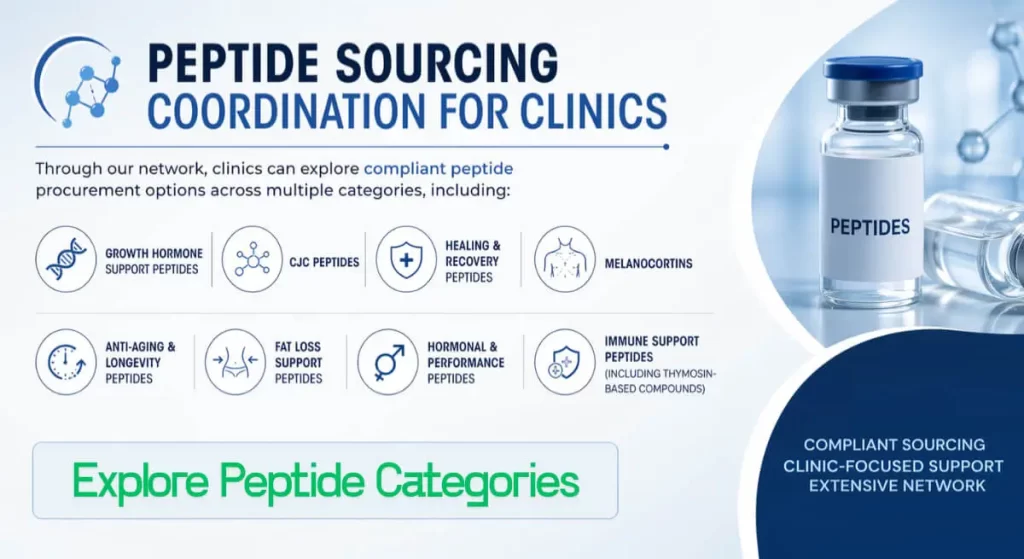
The Major Categories: Clinical Peptide Applications
When we look at the data and what clinics are actually ordering the usage generally falls into four or five main buckets. It is not just about one miracle drug. It is about a toolkit that helps providers solve problems for their patients.
Here is a breakdown of how we see peptides in medical practice today.
a) Metabolic Health and Weight Management
This is the big one. You cannot talk about this topic without addressing the GLP-1 agonists.
Alongside these, clinics are increasingly sourcing metabolic-focused peptides such as AOD-9604 and Tesamorelin, as well as newer options like MOTS-C, to support fat metabolism and energy regulation.
In the last few years drugs like Semaglutide and Tirzepatide have completely changed how clinics approach obesity and metabolic syndrome. These are peptides. They mimic a natural hormone in the body called glucagon-like peptide-1.
When a patient eats this hormone tells the brain they are full and it slows down how fast the stomach empties. It also helps the pancreas release insulin more effectively.
For a long time weight loss in a clinical setting was incredibly difficult. Diet and exercise are always the foundation but for many patients the metabolic deck was stacked against them. These peptide treatments overview a new era where obesity is treated as a chronic metabolic condition rather than just a willpower issue.
Clinics are seeing patients who have struggled for decades finally finding success. This not only improves their weight but often has downstream effects on their blood pressure, lipid profiles, and overall inflammatory markers.
b) Injury Repair and Recovery
This is a massive area for sports medicine clinics, orthopedics, and integrative wellness centers.
In this category, clinics often explore peptides such as BPC-157 and TB-500, along with combination protocols like BPC-157 + TB-500, to support soft tissue recovery, inflammation management, and overall healing processes.
The body has natural mechanisms for healing but sometimes they get stuck or slow down especially as we age. Certain peptides are researched for their ability to kickstart these repair processes.
So you will often hear about peptides like Body Protection Compound Page or Thymosin Beta-4 page) in research circles.
Note: It is vital to understand the regulatory status here. While the research is fascinating regarding soft tissue repair and inflammation reduction the FDA has recently placed some of these on the “Category 2” list regarding bulk compounding. This means licensed clinics need to be hyper-aware of what is currently compliant to prescribe and source.
However the goal remains the same. Providers are looking for ways to help patients recover from surgery faster, heal sprained ligaments, or manage chronic tendonitis. The concept is using clinical peptide applications to reduce downtime and get patients back to their active lives.
c) Anti-Aging and Aesthetic Dermatology
If you run a med-spa or a dermatology practice you know that patients are always looking for better skin quality.
In this space, peptides such as GHK-Cu are widely recognized for their role in supporting collagen production and skin health, while broader longevity-focused protocols may also include compounds like Epithalon and cellular support options such as NAD+.
Peptides are huge here. You have probably seen “copper peptides” in topical creams at the store. In a clinical setting providers might use more potent formulations.
GHK-Cu is a popular example. It is a copper peptide found naturally in the body but levels drop as we get older. It is known for supporting collagen production and skin elasticity.
Beyond just skin there is a focus on “healthy aging.” This isn’t about trying to live forever. It is about healthspan. It is about keeping the body functioning optimally for as long as possible. Clinics use certain peptides to help maintain muscle mass, improve sleep quality, and keep energy levels stable as patients enter their 50s, 60s, and beyond.
d) Immune System Modulation
The immune system is tricky. sometimes it is too weak (getting sick constantly) and sometimes it is too aggressive (autoimmune issues).
Within this category, clinics often look toward peptides such as Thymosin Alpha-1, along with supportive compounds like KPV, to help regulate immune response and maintain inflammatory balance.
There are peptides derived from the thymus gland which is the training center for your immune cells. Thymosin Alpha-1 is one that has been studied for years regarding its ability to help modulate immune response.
In a functional medicine context providers might look at these options for patients who feel “run down” or are dealing with chronic inflammatory states. It is about balance rather than just boosting.
Summary of Common Peptide Goals
To make this easier to digest here is a simple table showing the general intent behind these therapies.
| General Category | Typical Goal | The “Signal” Sent to the Body |
|---|---|---|
| Metabolic Health | Weight loss, blood sugar control | “I am full. Process this sugar efficiently.” |
| Repair & Recovery | Healing tissues, reducing inflammation | “Send repair crews to this injury site.” |
| Aesthetics | Skin tightness, hair growth | “Build more collagen. Repair skin barriers.” |
| Hormone Optimization | Vitality, muscle maintenance | “Release natural growth factors.” |
| Cognitive Health | Focus, mental clarity | “Protect neurons. Improve brain signaling.” |
Why Are Clinics Moving Toward Peptide Therapy?
You might be asking why this is happening now. Why the sudden explosion of wellness clinic peptides?
It comes down to a shift in patient expectations.
Patients are tired of the “sick care” model. Patients do not just want a pill to mask a symptom. They want a solutions and so they are doing their own research. They come into your clinic asking about things they read online.
For a clinic owner incorporating peptide programs in clinics is a way to meet that demand. It allows you to offer personalized care.
Instead of a one-size-fits-all beta-blocker you might look at a patient’s specific metabolic profile and tailor a peptide protocol that addresses the root cause of their insulin resistance.
It also fosters incredible patient retention. When a patient finally heals that old shoulder injury or finally loses that stubborn 20 pounds they become a patient for life. They trust you. They refer their friends.
From a business standpoint it diversifies your revenue. It moves you away from relying solely on insurance reimbursements and opens up cash-pay models for wellness and optimization services.
Safety and Sourcing
We have to be real with you. The peptide industry can be a bit of a “wild west” if you are not careful.
Because these treatments are popular there are a lot of shady websites selling “research chemicals” labeled “not for human use.”
As a licensed clinic you cannot touch those.
Your medical license is your lifeblood. You must ensure that anything you administer or prescribe comes from a legitimate source. This usually means FDA-approved commercial medications or, when appropriate and compliant, preparations from a 503A or 503B regulated compounding pharmacy.
This is where the headache usually starts for clinic owners.
Finding a pharmacy that can compound what you need, has high sterility standards, and actually has stock available is difficult. The supply chain is fragile. We saw this clearly when the GLP-1 shortages hit. Everyone was scrambling.
This is why peptide supply is such a critical topic. You can have the best clinical knowledge in the world but if you cannot get the product your patient care stops.
This is where InjectaConnect comes in. We do the legwork so you can focus on the patients. We do not make the drugs and we do not prescribe them. Injecta Connect acts as the bridge between your clinic and the licensed supplier.
We help you navigate the complex world of peptides sourcing for clinics by connecting you with a network of vetted high-quality suppliers who understand the regulatory landscape.
Navigating the Regulatory Landscape
We mentioned this earlier but it is worth repeating. The FDA monitors peptides closely.
Recently the FDA removed certain peptides from the list of substances that can be bulk compounded. This is known as the “Category 2” list. This created a lot of confusion in the market.
For example while Semaglutide (when on the FDA shortage list) can often be compounded certain other niche peptides might no longer be allowed to be compounded in bulk.
As a clinic owner you need to stay educated. You need partners who are watching these regulatory changes.
A good peptide program in a clinic is not just about knowing the science. It is about knowing the law. It is about knowing that what you are prescribing today is compliant with federal and state regulations.
We always advise our clinic partners to have a relationship with a legal expert in healthcare and to use a sourcing partner like us who prioritizes compliance over cutting corners.
How to Integrate This into Your Practice
If you are reading this and thinking “Okay I want to start offering this,” here is a simple way to think about it.
- Education First: Ensure your providers understand the pharmacology. There are great courses and certifications available for peptides in medical practice.
- Define Your Focus: Are you a weight loss clinic? An ortho clinic? A med-spa? Pick the peptides that fit your specialty. Don’t try to do everything at once.
- Secure Your Supply: This is vital. You need a reliable source for peptide supply for clinics. Do not wait until you have a patient waiting to find a supplier.
- Manage inventory and storage: Store peptides according to SOPs, supporting efficient operations and safe clinical use
- Create Protocols: Standardize how you will screen patients, what labs you will run, and how you will monitor progress.
- Patient Education: Be ready to explain this to your patients simply. Use the “Lego” or “Email” analogies we used above.
Disclaimer: InjectaConnect do not provide medical advice, patient care, prescribing, compounding, or dispensing services. The information in this article is for educational purposes only and is intended strictly for licensed medical professionals and clinic owners. All medical decisions should be based on the professional judgment of a licensed provider and in accordance with FDA regulations and state laws.
The Future of Peptides
We firmly believe we are just at the tip of the iceberg regarding peptides used in clinics.
Science is discovering new signaling sequences every year. The potential for treating chronic diseases, autoimmune conditions, and age-related decline is massive.
But with that growth comes responsibility. The clinics that win in the long run will be the ones that put patient safety first. They will be the ones who refuse to buy cheap questionable products from overseas. They will be the ones who partner with legitimate pharmacies and liaison services.
At InjectaConnect we are excited to be part of this journey with you. We love seeing clinics thrive. We love seeing the success stories of patients getting their lives back.
Conclusion
Peptides represent a powerful shift in medicine toward precision and signaling. They allow your clinic to offer treatments that work with the body’s natural processes rather than just suppressing symptoms.
From weight management revolutions with GLP-1s to tissue repair and skin health the applications are vast. But they require a steady hand. They require a commitment to quality and compliance.
If you are looking to expand your clinic’s offerings into this space take the time to do it right. Research your sources. Understand the regulations. And find partners who care as much about your license and your patients as you do.
If you need help figuring out the supply chain puzzle for your practice we are here to chat. Let’s make sure your clinic is stocked, compliant, and ready to serve your community.
Medical Disclaimer:
The information contained within this article is provided solely for the benefit of licensed clinics and healthcare providers and does not represent medical advice to the readers. There exist many different types of peptides that are non-regulated or not approved for general use as medicines by regulatory agencies. Each provider is responsible for making their own determinations based upon their clinical experience and knowledge of applicable regulations. Patients must obtain their own advice from an appropriately qualified medical practitioner before considering any course of action related to peptide therapy.