
Peptide Supplier vs Compounding Pharmacies: What Clinics Must Know?
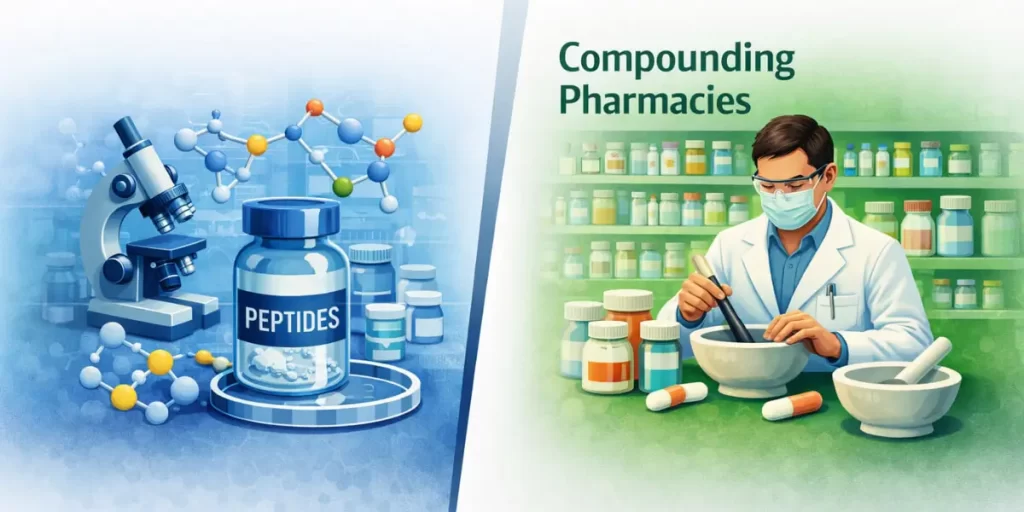
If you run a clinic, you have probably noticed that “peptides” is one of those words that gets used in a lot of different ways. Sometimes it means an FDA approved injectable drug with a clean label and a known NDC. Sometimes it means a 503A compounded preparation made for a specific patient. And sometimes it means a vial sold by a “peptide supplier” that is not a drug at all, even if it looks like one.
That is where most compliance headaches start because sourcing peptides through licensed channels play an important role in the peptide sourcing process.
This guide breaks down the key differences between a peptide supplier vs compounding pharmacy, with an industry comparison lens. It is written for licensed clinics and medical professionals making real purchasing decisions, not for patients. And since InjectaConnect does not provide medical advice, patient care, prescribing, compounding, or dispensing services, nothing here should be read as clinical or legal advice.
The simplest way to frame a Peptide Supplier vs Compounding Pharmacy
Here is the most useful mental model:
- A peptide supplier is typically a chemical supplier or research-use vendor selling peptides as materials, often labeled “RUO” (research use only) or “not for human use.” Even if clinicians purchase them, that does not automatically make them appropriate for clinical administration.
- A compounding pharmacy is a licensed pharmacy that prepares a medication from ingredients under a regulated framework (typically 503A for patient specific prescriptions, or 503B for outsourcing facilities under additional federal oversight).
So the key difference is not the vial. It is the regulatory pathway, intended use, and accountability chain. In short peptide supplier take the research route and compounding pharmacy take up the clinical route.
Why this matters more now than it did a few years ago
In the United States, peptides sit in the middle of several fast-moving regulatory and market forces:
- GLP-1 related demand has made peptide sourcing options a daily operational issue for many clinics. That increased scrutiny on compounding and sourcing in general.
- The FDA has repeatedly warned the market about unapproved products marketed in ways that imply they are safe or equivalent to approved drugs, including products labeled as research chemicals but promoted for human use.
- State boards of pharmacy and medical boards increasingly expect clinics to show clear documentation for “peptide procurement methods” and medication pedigree, not just invoices.
Clinics are realizing that “peptide supply channels” are not interchangeable. Whether you choose a wholesaler or a pharmacy, maintaining compliant peptide sourcing is the only way to protect your medical license
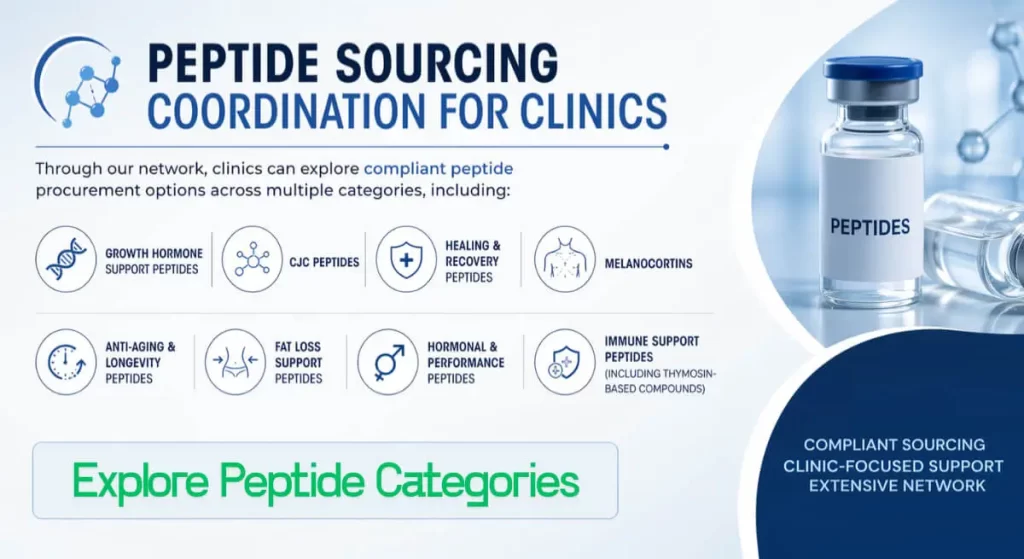
Peptide Supplier vs Compounding Pharmacy: Detailed Definitions that keep teams aligned:
What most people mean by “peptide supplier”
In the clinic world, a “peptide supplier” often refers to a company selling peptide vials online, sometimes with COAs, sometimes with third-party testing, sometimes with very little. Many of these vendors position themselves as research suppliers. That means:
- The product may be labeled RUO or “not for human use.”
- The vendor is not operating as a pharmacy.
- The product is not dispensed pursuant to a prescription.
- There is typically no patient specific labeling that aligns with FDA drug labeling conventions.
While the peptide may be chemically “the same sequence,” it is not thereby the same as a regulated drug product in sterility assurance, manufacturing controls, labeling, storage controls, and post-market accountability.
What a compounding pharmacy is (503A and 503B)
Compounding pharmacies are designed to provide customized medication where an FDA-approved product is not suitable for a patient’s clinical need, or where a drug is not commercially available.
Common categories:
- 503A compounding pharmacies: State licensed pharmacies that generally compound patient specific prescriptions.
- 503B outsourcing facilities: Facilities that can compound in larger batches and supply to healthcare facilities, subject to additional federal requirements and FDA inspection focus.
These categories and expectations are described in FDA materials on compounding and the Federal Food, Drug, and Cosmetic Act framework.
Industry comparison that actually helps: Peptide distribution vs compounding (high-level comparison)
Below is a practical comparison you can share with a clinic manager, compliance lead, or medical director.
| Topic | Peptide supplier (often RUO / chemical supply) | Compounding pharmacy (503A / 503B) |
|---|---|---|
| Primary business model | Sale of peptides as chemicals or research materials | Preparation and dispensing or distribution of compounded medications under pharmacy regulation |
| Intended use (typical labeling) | “Not for human use” or RUO | For administration pursuant to prescription or facility order (depending on 503A vs 503B and state rules) |
| Regulatory lane | Not an FDA approved drug; may not be a drug at all in how it is marketed | Operates under pharmacy laws and FDA compounding policies; still not FDA approved drugs, but regulated as compounded meds |
| Sterility assurance expectations | Varies widely; may not follow sterile drug compounding standards | Sterile compounding standards and quality systems expected (scope depends on 503A vs 503B) |
| Labeling norms | Often minimal; may not match drug labeling standards | Pharmacy labeling conventions, beyond-use dating, lot info; patient specific labeling in 503A |
| Traceability | Often limited to supplier COA and invoice | Pharmacy records, lot tracing, prescription records, and pharmacy accountability |
| Clinic risk profile | Higher risk of misalignment with intended use and clinical administration | Lower risk when used appropriately, but still requires diligence and compliance review |
| Typical clinic use case | Education, R and D, or non-clinical research environments | “Peptide supply for clinical use” when a compounded preparation is clinically justified and legally ordered/dispensed |
This is the core difference in the peptide supplier vs compounding pharmacy question: one channel generally sells chemicals, the other prepares medications under pharmacy oversight.
The third lane that clinics sometimes forget: FDA approved peptide drugs
Not every peptide conversation should default to compounding or suppliers.
Many peptide based therapies are FDA approved as finished drug products (examples exist across endocrinology, oncology, metabolic disease, and more). FDA approved labeling matters because it defines:
- Indications
- Dosing and administration
- Contraindications and warnings
- Storage and handling
- Presentation and strength
- Manufacturer quality requirements
For clinics building a clean compliance narrative, FDA approved products are the simplest to defend from a sourcing standpoint because the supply chain is well-defined.
This does not mean FDA approved is always available or fits every patient scenario. It just means your peptide sourcing options should start with: “Is there an FDA approved option that fits?” Then, only if there is a legitimate gap, you evaluate compounding.
What “quality” means in each channel (and why COAs are not enough)
A lot of buyers rely heavily on a Certificate of Analysis. COAs can be useful, but clinics often overestimate what a COA proves.
For peptide suppliers
A COA might show identity and purity testing on a sample, but it may not reliably cover:
- Sterility and endotoxin in a way that supports clinical injection
- Robust lot-to-lot consistency
- Container closure integrity
- Cold chain handling
- Stability in the final container
- Quality management systems aligned with drug manufacturing expectations
A clinic might feel reassured because a document exists, but regulators usually care about the whole system, not a single sheet.
For compounding pharmacies
A compounding pharmacy’s quality story should be broader than a COA. For example, many clinics ask about:
- Sterile compounding standards and environmental monitoring practices
- Beyond-use dating rationale
- Lot and batch records
- Recall process
- Complaint handling process
- For 503B, FDA inspection history and quality metrics (when available)
None of this is about perfection. It is about having a defensible process.
Concrete examples clinics run into (real-world, non-clinical)
1: The vial looks identical, but the compliance story is not
Two vials arrive in similar packaging. One is from a website that calls itself a “medical peptide provider” but labels the product RUO. The other is dispensed from a 503A pharmacy with a patient label and prescriber info.
From a purchasing perspective, both feel like “peptides.” From a regulatory perspective, those are completely different stories. If something goes wrong, your documentation trail and intended use alignment will matter.
2: Staff training and SOPs differ by channel
When clinics use compounded sterile preparations, they often build SOPs around:
- Receiving logs
- Refrigeration monitoring
- Lot tracking
- Patient-specific labeling checks
- Documentation in the medical record
With peptide supplier purchases, clinics often have fewer formal workflows because the purchase is treated like a commodity. That gap is where operational risk accumulates.
3: Marketing language creates risk
Some vendor sites use language that heavily implies clinical outcomes or human administration while still using RUO disclaimers. FDA has historically scrutinized products marketed as unapproved drugs, including those that try to have it both ways. For clinics, that creates reputational and compliance exposure, even if the product “tests fine.”
Sourcing peptides for licensed clinics: a decision framework (non-clinical)
Here is a simple, clinic-friendly way to think through peptide procurement methods without stepping into medical advice.
Step 1: Start with the product category
Ask: Is what you are buying clearly one of the below?
- FDA approved drug product from an authorized distributor
- Compounded preparation from a 503A pharmacy (patient specific) or 503B outsourcing facility
- Research chemical / RUO peptide supplier product
If your team cannot confidently classify it, pause and escalate internally.
Step 2: Validate the paperwork that matches the category
- FDA approved: NDC, labeling, authorized distribution, storage requirements, pedigree documentation
- 503A/503B: pharmacy license verification, patient-specific documentation as applicable, compounding records and quality documentation as appropriate, beyond-use dating, lot tracking
- RUO supplier: clear non-clinical intended use, internal controls to prevent clinical administration
Step 3: Align your SOPs to the risk
Your documentation rigor should match the risk level and the regulatory expectations of the channel.
“Clinic peptide suppliers” is a confusing phrase (and how to clarify it internally)
Many companies brand themselves as “clinic peptide suppliers” even when they are not pharmacies and not drug manufacturers. That does not automatically mean they are doing something illegal. It does mean you should clarify what they are:
- Are they a licensed wholesaler distributing FDA approved drugs?
- Are they a 503B outsourcing facility?
- Are they a reseller or marketplace?
- Are they a chemical supplier selling RUO peptides?
This is not semantics. This is the difference between peptide distribution vs compounding vs chemical supply.
What to ask vendors (practical checklist)
Below are non-clinical, operations-focused questions that help clinics compare peptide supply channels.
If you are evaluating a compounding pharmacy (503A or 503B) ask your vendor
- Are you licensed in my state, and can you provide verification?
- Are you 503A or 503B?
- What sterile compounding standards do you follow and what is your environmental monitoring approach?
- What is your process for beyond-use dating assignment?
- How do you handle recalls and notifications?
- What lot tracking details will appear on the label and paperwork?
Ask these if you are evaluating a peptide supplier (RUO or chemical supplier)
- Is the product labeled RUO or not for human use?
- What is the exact intended use and can you provide it in writing?
- What testing is performed per lot, and is sterility/endotoxin testing performed in a way that supports sterile injection (if they claim that)?
- What is the chain of custody and storage handling process?
- What is the returns and complaint process?
If the answers feel vague, that itself is a signal.
How FDA approved labeling fits into this conversation
Even when you are not purchasing an FDA approved peptide drug, FDA approved labeling is still the gold standard reference for what “drug grade” labeling and accountability look like.
FDA labeling sets expectations around:
- Exact active ingredient naming
- Strength and concentration expression
- Route of administration
- Storage conditions
- Contraindications and warnings language
- Manufacturer identification and lot control
Clinics can use those labeling conventions as a benchmark to spot when a product is being presented like a drug without the corresponding oversight.
Where InjectaConnect fits (and does not fit)
InjectaConnect is not a pharmacy, does not prescribe, does not compound, and does not dispense. In a liaison role, the practical value is helping clinics think clearly about peptide sourcing options, documentation expectations, and how to evaluate “medical peptide providers” in a way that supports internal compliance.
In other words, we help you ask better questions and build cleaner purchasing workflows. Your licensed team makes the clinical and legal decisions.
Bottom line
For licensed clinics, the peptide supplier vs compounding pharmacy decision is really a choice between fundamentally different supply channels. One is usually chemical supply with research intent. The other is pharmacy regulated medication preparation with clearer clinical documentation norms. And sitting above both the FDA approved peptide drugs offer the most straightforward labeling and traceability because they are the gold standard.
If you are working on sourcing peptides for licensed clinics, the safest operational habit is consistency: classify the channel, match the paperwork to the channel, and document your rationale the same way every time.
Related Resources
Peptide Procurement Workflow, Compliance & Best Practices for Clinics
How Licensed Clinics Choose Reliable Peptide Sourcing Partners