
How Licensed Clinics Choose Reliable Peptide Sourcing Partners

For licensed clinics, finding peptides is rarely the hardest part. The harder part is finding a sourcing partner that can consistently provide the right documentation, the right storage conditions, and the right level of transparency when the clinic needs it most.
That is why peptide sourcing partners for clinics are judged on more than price or product availability. Clinic procurement teams are really asking, “Can we rely on this partner if a shipment is delayed, a lot number needs to be traced, or compliance asks for records?”
This is due to the fact that procurement of peptides lies in the crossroad of quality of the product, expectations of the FDA, pharmacy regulations, shipping regulations, and risks in clinics. Peptides may either be FDA-approved for certain applications or obtained via other legal means. The right course of action varies depending on the type of product and its application.
1) What clinics are actually evaluating
When a medical facility is searching for a company or an organization that will serve as its source for peptides, they are actually analyzing five key factors simultaneously:
- Compliance compatibility: Is the potential partner running its business in compliance with relevant legislation?
- Quality control: Does the company keep track of all manufacturing, testing, release, and shipping processes?
- Availability of the product: Is there going to be enough product to order repeatedly without shortages?
- Logistics: Is it possible to get the product delivered under cold chain conditions?
- Communication skills: Is there always a contact person who can speak to the clinic’s staff clearly and professionally?
A strong peptide procurement workflow for clinics is not built on the cheapest quote. It is built on fewer surprises.
A small clinic might start with a simple purchasing need, then discover that one missing COA, one late shipment, or one unclear lot number creates more work than the peptide order was worth. That is why experienced buyers look at the whole chain, not just the product page.
2) Regulatory and compliance considerations in peptide sourcing
This is where many clinic procurement decisions are won or lost.
In the U.S., clinics should not treat peptide sourcing like ordering office supplies. The product category matters. A peptide may be part of an FDA approved drug, may be compounded by a pharmacy or outsourcing facility when permitted, or may fall into a category that is not appropriate for patient care. Not all peptides are FDA approved, and a vendor saying “pharmaceutical grade” is not a substitute for documentation.
Clinics usually want to confirm:
- Who manufactured the product
- Whether the manufacturer or pharmacy is licensed and registered as required
- Whether the product is appropriately labeled for clinical use
- Whether the lot can be traced
- Whether the product path is consistent with federal and state rules
For many clinics, the compliance review includes checking state pharmacy licensure, FDA registration where relevant, and whether the sourcing path aligns with the clinic’s use case. If a product is compounded, the clinic may also expect the partner to understand applicable USP standards, sterile handling requirements when relevant, and the pharmacy’s quality controls.
A practical rule: if the supplier cannot clearly explain the product category, the clinic should pause. In regulated healthcare purchasing, clarity is a compliance feature.
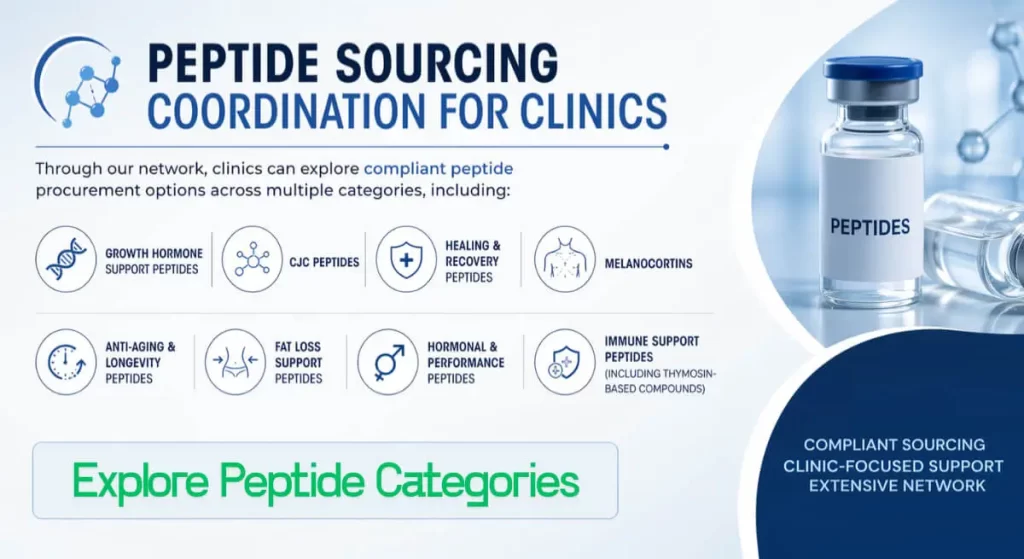
3) Supplier vs coordinator model
Many clinics now compare two basic options: a direct supplier model and a coordinator model.
In the direct supplier model, the clinic buys more or less straight from a manufacturer, authorized distributor, pharmacy, or outsourcing facility. In the coordinator model, a peptide procurement network for clinics helps source, organize, or route orders through a vetted set of partners.
Neither model is automatically better. The right choice depends on how much control the clinic wants, how much documentation it needs, and how much sourcing complexity it can manage internally.
Here is a simple comparison:
| Sourcing option | Typical price | Reliability | Compliance visibility | Speed | Best fit |
|---|---|---|---|---|---|
| Direct manufacturer | Often lower at scale | High if the manufacturer is well qualified | Strong if documentation is robust | Medium | Clinics with steady volume and internal QA support |
| Authorized distributor | Moderate | Usually high | Good traceability and standardized paperwork | Fast to medium | Clinics that want simpler ordering and fewer exceptions |
| Coordinator platform or network (For Example InjectaConnect.Com) | Can be competitive, varies | Depends on network controls | Must be verified carefully | Often fast once the network is established | Clinics that want sourcing support and less vendor sprawl |
| 503A or 503B pharmacy path, where appropriate | Often higher | High when the pharmacy is well vetted | Strong for compounding documentation | Medium to fast | Clinics needing pharmacy-based fulfillment under the right rules |
The important point is this: a coordinator is not a substitute for due diligence. A good coordinator can reduce administrative burden, but the clinic still needs to know who is actually making the product, who is handling release, and who owns the documentation if something goes wrong.
For some practices, especially smaller clinics, a peptide sourcing network can be useful because it reduces vendor sprawl. For larger groups, direct supplier relationships may offer better control over pricing and forecasted demand.
4) Quality assurance: COAs, GMP standards, and third-party testing
Quality assurance is where reliable partners separate themselves from persuasive marketers.
Clinics should expect clear documentation, not vague promises. The most common quality records include:
- Certificate of Analysis, or COA
- Lot or batch number
- Manufacturing or pharmacy release information
- Identity and purity data
- Potency information, when applicable
- Sterility or endotoxin testing, when relevant
- Storage and stability guidance
- Expiration or beyond-use information
- Chain of custody or shipping records
A COA should match the exact lot that arrives. A generic COA that looks nice but does not match the shipment is not enough.
GMP, or good manufacturing practice, is another major signal. GMP does not mean a product is automatically right for every clinic or every use, but it does show the producer is working within a documented quality system. For clinics, that matters because it lowers the odds of inconsistent manufacturing, contamination issues, and unreproducible lots.
Third-party testing can also help, but only if it is meaningful. Clinics should ask:
- Is the testing lot-specific?
- Is the lab independent?
- Is the lab credible and appropriately qualified?
- Do the results actually match the product being delivered?
A good sourcing partner welcomes these questions. A weak one treats them like an inconvenience.
5) Logistics matter more than many clinics expect
For peptides, logistics are part of quality.
A product can be manufactured well and still arrive compromised if the shipping process is weak. That is why clinics often ask about cold chain handling, insulated packaging, temperature monitoring, and delivery timing before they place an order.
A reliable partner should be able to explain:
- How the product is packaged for transit
- Whether refrigeration or frozen shipment is required
- What happens if a package is delayed
- Whether temperature indicators or data loggers are used
- How receiving should be documented on arrival
- How quickly the clinic should move the product into storage
A clinic with a busy receiving desk may prefer morning delivery windows and clear tracking updates. A rural clinic may care more about weekend coverage and backup ship dates. A multi-site practice may care about standard receiving procedures so every location handles the shipment the same way.
This is one reason reliable peptide sourcing partners for clinics are often judged by service quality, not just product selection. A good partner reduces risk before the product ever reaches the refrigerator.
6) Risk mitigation: counterfeit products and inconsistent supply
Counterfeit or misrepresented products are a real concern in any healthcare supply chain. Clinics can reduce that risk by looking for red flags early.
Common warning signs include:
- Prices that are far below market with no explanation
- Missing lot numbers or vague labeling
- No clear physical business address
- Refusal to provide documentation
- Overuse of marketing terms like “pharmaceutical grade” without proof
- Inability to answer basic questions about storage or release
- Pressure to buy quickly before the clinic can review records
Another risk is supply inconsistency. A clinic might find a product once, then discover it disappears for weeks. That creates operational stress, especially if the product is part of a recurring workflow. Reliable partners often solve this with better forecasting, reserve inventory, or a broader peptide procurement network for clinics.
Many clinics protect themselves by qualifying more than one approved source when possible. That does not mean buying from everywhere. It means having backups that have already passed the clinic’s review before a shortage happens.
7) Cost vs reliability trade-offs
Price matters, but price alone is a poor decision rule.
A lower unit cost can be attractive until you factor in hidden costs like:
- Staff time spent chasing documents
- Wasted orders from shipping delays
- Product loss from poor temperature control
- Compliance review time
- Reordering costs during shortages
- Reputational risk when the clinic cannot explain its sourcing
In practice, the cheapest option is not always the least expensive. The least expensive option is the one that arrives correctly, is documented properly, and does not create downstream problems.
A clinic owner in a busy metro practice may choose a slightly higher-priced partner because the documentation is always clean and delivery is predictable. A smaller clinic may accept a bit more cost for a coordinator model if it saves staff time and reduces the number of vendors the team must manage.
That is the real trade-off in clinic procurement decisions: you are not just buying peptides, you are buying reliability.
8) Real-world decision criteria clinics actually use
When clinics compare peptide sourcing partners, the final decision often comes down to practical questions like these:
- Can we get a lot-specific COA without chasing someone for three days?
- Does the vendor respond like a professional healthcare supplier?
- Can they explain the difference between what they sell and what they do not sell?
- Do they provide clear shipping updates and tracking?
- Is there a documented process for recalls, damaged shipments, or temperature excursions?
- Will this relationship hold up under audit or internal review?
- Can the partner support our peptide procurement workflow for clinics as we grow?
A common pattern looks like this: a clinic starts with one supplier, then realizes it needs a better documentation process, then shifts to a more structured supplier vs coordinator peptides model. The best partners make that transition easier, not harder.
9) A practical way to evaluate partners
If your clinic is building or revising its sourcing process, a simple review sequence can help:
- Define the product need clearly such as product type, form, storage requirements, and volume.
- Check regulatory fit. Confirm the sourcing path matches the product category and clinic use.
- Review the documentation such as COA, licensure, release documents, labeling, and traceability.
- Assess logistics that includes packaging, cold chain, delivery windows, and receiving SOPs.
- Test communication. Ask a few real questions and watch how the partner responds.
- Start with a controlled order. Many clinics begin with a small, documented trial before approving broader use.
- Review ongoing performance. Track fill rate, on-time delivery, documentation quality, and issue resolution.
That process may sound simple, but it is exactly how stronger procurement teams reduce risk.
Conclusion
Choosing reliable peptide sourcing partners for clinics is really about building a procurement system the clinic can trust. Partners who combine regulatory clarity, quality documentation, cold chain discipline, and responsive service are more reliable than those who are not. Compliant suppliers do not just sell product, they help clinics keep its workflow clean and defensible.
Therefore, whether your clinic prefers a direct supplier model or a coordinator platform, the rule applies equally for all. Verify everything that matters, especially the product category, the documentation, and the logistics because in a regulated environment, reliability is not a luxury. It is part of the job.
Medical Disclaimer:
The information provided herein is for the exclusive use of licensed healthcare clinics only, to facilitate their needs for procurement purposes. InjectaConnect does not offer any medical advice or patient care services, prescribing, compounding, or dispensing.
Related Resources:
Peptide Procurement Workflow, Compliance & Best Practices for Clinics
Peptide Supplier vs Compounding Pharmacies: What Clinics Must Know?