
Peptide Procurement Workflow, Compliance & Best Practices for Clinics
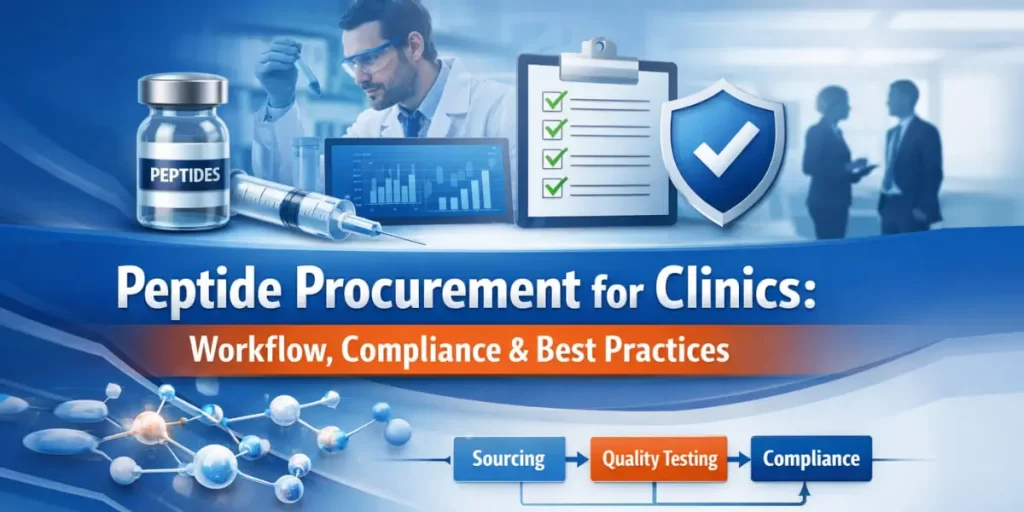
This article is written for licensed clinics and medical professionals and focuses on peptide procurement workflow and operational processes for clinics. It does not provide medical advice or recommend specific therapies.
Licensed clinics are getting more serious about peptide procurement, and for good reason. Peptides show up in many corners of modern care, from FDA approved therapies with established labeling to ongoing research and off-label interest that can create real operational demand in a practice.
Peptide procurement for clinics or in other words, clinical peptide procurement – is not like ordering gauze or syringes.
It touches drug labeling, storage controls, state and federal distribution rules, quality systems, and documentation that you may need at any moment for an audit, an insurer question, or an internal quality review
This guide focuses specifically on the operational workflow clinics use to manage peptide procurement safely and consistently through B2B channels in the United States. This guide outlines what ‘good’ looks like in the peptide supply chain, and how to reduce risk while keeping operations smooth.
1) Start with the most important question: What do you mean by “peptide”?
In clinic conversations, “peptide” can mean several very different things:
- FDA approved peptide drugs
These are finished drug products approved by the FDA, distributed through regulated channels, and supported by official prescribing information. - Compounded preparations that include peptide APIs
A licensed compounding pharmacy prepares these under specific conditions, and clinics must not manufacture them themselves unless they are properly licensed and compliant. - Research use only materials
These are not intended for human use. Clinics should treat this category with extreme caution because it can create compliance and patient safety issues if misused.
Therefore, in sourcing peptides for clinics, the safest operational baseline is simple: clinics should use FDA-approved drug products for patient care or work with appropriately licensed pharmacies and distributors, ensuring that all documentation is in place.
2) The regulated path most clinics use: FDA approved drug labeling and authorized distribution
In the United States, FDA approved drugs move through a structured distribution system designed to protect patients from counterfeit or diverted product. The key operational idea is this:
A legitimate clinic peptide procurement workflow or process ties every product back to an authorized trading partner and a traceable supply chain.
If your clinic is buying an FDA approved peptide drug, you will usually source it from one of these channels:
- A wholesale drug distributor
- A manufacturer or authorized specialty distributor
- A licensed pharmacy partner (depending on your model and state rules)
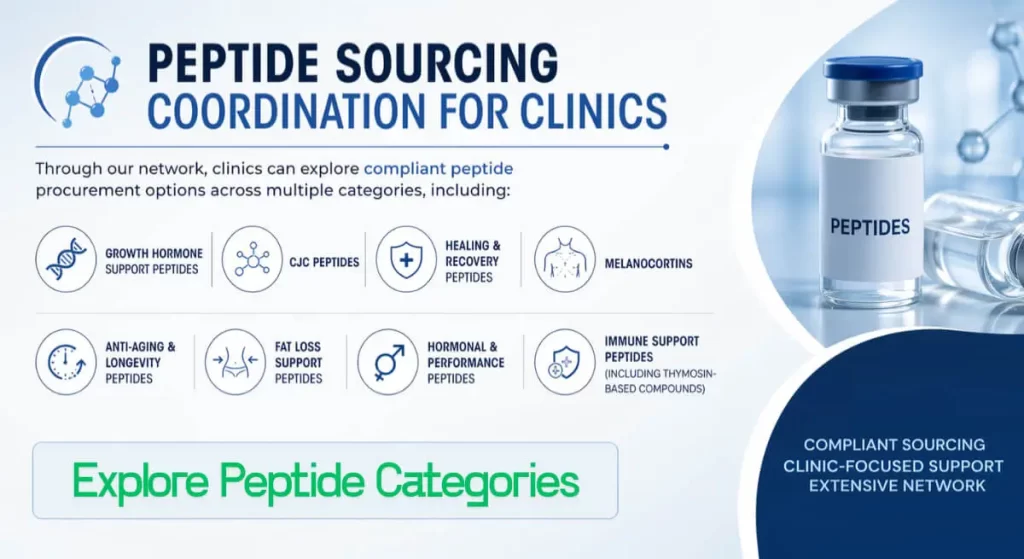
This is where the phrase peptide distribution network becomes real. It is not marketing. It is who is authorized to sell, who is authorized to buy, and what documentation proves it.
Why FDA labeling matters so much in peptide procurement for clinics
FDA approved drug labeling is the common reference point for:
- Indications and usage
- Dosage and administration details
- Storage and handling
- Contraindications and warnings
- Presentation forms (vial, prefilled pen, etc.)
Even when clinicians use professional judgment in real world care, your operational sourcing process should still be anchored to the labeling for what the product is, how it is packaged, and how it should be stored and tracked.
3) What clinics look for in peptide procurement workflow for clinics
When clinics search for licensed pharmacy partners, they are usually looking for more than pricing. The best buyers tend to evaluate suppliers like a risk manager would.
Here is a simple way to think about it: sourcing is not just procurement. It is compliance plus continuity.
A practical comparison table for B2B supplier evaluation
| What clinics evaluate | What “good” looks like | Why it matters |
|---|---|---|
| Licensing and authorization | Sourcing partner can provide verifiable state licenses and is an authorized trading partner | Helps reduce counterfeit, diversion, and regulatory risk |
| Product documentation | Clear NDC info for FDA approved drugs, lot numbers, expiration, invoices | Supports traceability and DSCSA style documentation practices |
| Cold chain handling | Validated shipping practices, temperature controls when required | Protects product integrity and reduces waste |
| Recalls and returns process | Clear recall notifications, return rules, quarantine procedures | Protects patients and reduces operational chaos |
| Consistent supply | Backorder transparency and options for therapeutic equivalents where appropriate | Keeps schedules and patient workflows stable |
| Storage guidance | Alignment with FDA labeling storage requirements | Helps avoid spoilage and compliance gaps |
| Contract terms | Straightforward terms, no vague product descriptions | Prevents procurement mistakes |
Note: DSCSA (Drug Supply Chain Security Act) is a major driver behind traceability expectations for many prescription products. Clinics do not need to be legal scholars, but you do want suppliers who can support documentation and traceability expectations.
4) Typical clinic peptide procurement process (what it looks like)
Most practices that do this well rely on a repeatable process. Here is a common, practical workflow for clinic peptide procurement.
1: Define the product category and intended pathway
Before you buy anything, internally clarify:
- Is this an FDA approved drug product?
- Will it be ordered through your wholesaler account?
- Will it be fulfilled by a licensed pharmacy partner?
- Are there storage requirements (refrigeration, light protection, limited room temp stability)?
2: Vet the medical peptide vendors
A supplier should be able to provide, at minimum:
- Proof of licensure in relevant states
- Traceable invoices
- Product identifiers such as NDC for FDA approved drugs
- Lot and expiration data
- Shipping and temperature control details if applicable
If a vendor is vague, avoids documentation, or markets “research only” materials in a clinical purchasing context, treat that as a red flag. Understanding common challenges in peptide procurement can help clinics identify these risks earlier and strengthen sourcing and compliance practices.
3: Align internal receiving and storage procedures
A lot of peptide loss happens at the receiving step. Clinics that run smoothly usually do this:
- Assign a trained receiver
- Check shipment condition immediately
- Confirm product name, strength, quantity, lot, and expiration
- Record temperatures if required
- Store according to labeling right away
4: Maintain inventory records that a future audit can understand
Clinics do not just need inventory. They need inventory that tells a coherent story:
- What was ordered
- From whom
- When it arrived
- Where it was stored
- How it was used or transferred according to your policies
This is part of running a clean peptide supply chain within your four walls, where peptide inventory management becomes critical.
5: Plan for shortages without panic buying
Backorders happen. A mature workflow includes:
- Minimum on hand thresholds
- Reorder points based on appointment forecasts
- A second approved supplier when possible
- A documented substitution policy that stays within labeling and clinician judgment
5) How clinics handle compounded peptide preparations (high level, operationally)
Some clinics work with compounding pharmacies for patient specific needs when clinically appropriate and legally permissible.
A few operational notes that clinics commonly standardize:
- Verify the pharmacy is properly licensed and, when relevant, check whether it is registered as a 503A pharmacy or operates as a 503B outsourcing facility, depending on the model.
- Request documentation that supports the pharmacy’s quality systems and sourcing.
- Document ordering, receiving, and storage with the same seriousness as FDA approved products.
This article does not provide guidance on what should be compounded or prescribed. The point is simply that the procurement pathway should be formal and documented, not informal.
6) Common pitfalls in peptide procurement for clinics (and how to avoid them)
Clinics usually get into trouble in predictable ways. Here are the big ones.
1: Treating peptides like supplements
Peptides used in medical clinics are not the same as nutraceuticals. FDA approved peptide drugs come with labeling and regulated distribution.
What helps: Require documentation for every order. If the supplier cannot produce it, do not rationalize the gap.
2: Buying based on a product name without verifying the exact presentation
Two items can sound similar but be totally different in:
- Strength
- Delivery form
- Storage requirements
- Instructions in labeling
What helps: Match product to labeling and confirm NDC and package configuration before purchase.
3: Weak cold chain practices
If a peptide product requires refrigeration, temperature excursions can quietly ruin your inventory.
What helps: Train staff to immediately receive and store product. Use temperature monitoring where appropriate. Ask suppliers about shipping validation.
4: Poor lot and expiration tracking
When you need to respond to a recall or a clinical question, you need lot level clarity.
What helps: Record lot and expiration at receiving. Do not rely on memory or “we always use the newest box first.”
5: Overreliance on a single source
One disruption can cancel days of appointments.
What helps: Build an approved backup option and a realistic reorder cadence.
7) What documentation should a clinic expect from regulated sourcing partners?
For FDA approved drug products, clinics often expect:
- Invoice with seller and buyer details
- NDC and product description that matches labeling
- Lot number and expiration date
- Shipping details, and temperature related documentation if required
- Return and recall policy
For the internal clinic file, it is also helpful to keep:
- Supplier licenses and credentials on file
- Your receiving logs
- Temperature logs if you store cold chain products
- Written SOPs for ordering, receiving, and inventory control
Think of it this way: if a new manager walked into your clinic, could they understand your peptide supply for clinics in one afternoon without guessing?
8) A concrete example: How a mid size clinic simplifies peptide workflow
Imagine a concierge internal medicine clinic that uses a small set of FDA approved peptide drugs as part of its broader services. Their old process was:
- One person orders whenever they notice stock is low
- Products arrive, sometimes sit at the front desk
- Lot numbers are not consistently recorded
What they changed:
- They chose two approved licensed pharmacy partners with clear documentation and consistent fulfillment.
- They created a one page receiving checklist based on labeling storage requirements.
- They set reorder points tied to their appointment calendar.
- They stored invoices and lot records in a shared, auditable folder.
Result: fewer urgent orders, fewer wasted vials, and cleaner compliance posture.
This is what good peptide workflow for clinics looks like in practice. Not complicated. Just consistent.
9) Where a liaison partner like InjectaConnect fits (without practicing medicine)
Clinics often don’t need more information. They need fewer moving parts.
A liaison partner can help with:
- Organizing procurement workflows
- Connecting clinics with appropriate vendor networks
- Standardizing documentation collection
- Improving ordering and inventory processes
But not with:
- Prescribing decisions
- Patient specific guidance
- Compounding, dispensing, or clinical care
In other words, the goal is operational clarity and a more reliable peptide distribution network, while clinical decisions remain where they belong, with licensed professionals and FDA approved labeling.
As the demand for peptide-based therapies continues to grow, understanding how licensed clinics choose reliable peptide sourcing partners becomes essential for ensuring patient safety, regulatory compliance, and consistent treatment outcomes.
10) Quick checklist for peptide procurement workflow /process for clinics (simple and usable)
Use this as an internal self audit.
| Clinic checkpoint | Yes or no |
|---|---|
| We only purchase patient use products from appropriately licensed sources | |
| We can tie each product to an invoice and traceable sourcing partner | |
| We record lot numbers and expiration dates at receiving | |
| We store products exactly as FDA labeling describes | |
| We have a temperature process for refrigerated shipments | |
| We have a recall and quarantine procedure | |
| We have reorder points and a backup supplier plan | |
| We can explain our peptide sourcing for clinics process to a new hire |
Final note (compliance and scope)
This article is for educational and operational purposes for licensed clinics and medical professionals. It does not provide medical advice and does not recommend any therapy, indication, dosing, or compounding practice. For any FDA approved peptide drug, defer to the FDA approved prescribing information and your clinical judgment, and follow all applicable federal and state requirements.
If you want, I can also create a one page SOP template for “peptides sourcing for clinics” that covers vendor vetting, receiving, storage, documentation, and recall handling in plain language.
Important disclaimer: InjectaConnect is not a licensed medical provider or pharmacy and does not provide medical advice, patient care, prescribing, compounding, or dispensing services. This article is educational and operational in nature. Clinical decisions must be made by licensed clinicians. For any specific product, rely on the FDA approved prescribing information (drug labeling), and follow federal and state law and your facility policies.
Related Resources
How Licensed Clinics Choose Reliable Peptide Sourcing Partners
Peptide Supplier vs Compounding Pharmacies: What Clinics Must Know?